It’s Trans Visibility Day, which seems an appropriate date to let people know that I’ve started using they/them pronouns. It’s been a gradual change, so this might be old news to you. But more widely, I’m taking the chance to share my personal thoughts on some common questions people have about gender.
My pronouns
The headline: I’m using they/them pronouns now. I’d much rather people use ‘they’ in referring to me. In a sense, that’s it. End of post. That’s all anyone else needs to know.
The journey to this decision has been long and involved. It’s something that’s very important to me, but doesn’t affect other people much at all.
However, if you are curious to know a few of my thoughts around it, keep reading for my answers to 5 common questions.
No-one owes an explanation
This post is an edited version of a post I shared amongst friends a while ago. Friends who were keen to reassure me that I didn’t owe them an explanation. I was hugely grateful for that.
It’s true. Gender is a very personal experience and no-one owes anyone an explanation on their personal journey.
It’s also important to stress that a lot of the questions people have about gender can’t be answered objectively. I’m sharing my personal experience to help give people an insight into one element of the trans/non-binary experience.
My aim is to raise awareness and support the trans community, but not to talk on behalf of the community.
1. What if people get my pronouns wrong?
Honestly, it’s fine. Just correct yourself, or try to remember next time.
To me, there are 3 categories people fall into:
- Making the effort: People who actively make the effort to use ‘they’ and other gender-neutral terms. That makes me actively happy; it’s an act of validation that I really appreciate.
- Struggling with change: People who struggle with change/processing/remembering, but try where they can. A lot of my most trusted people still use ‘she’ for me, at least some of the time. Habits are hard to break. Please try, but I won’t hate you for getting it wrong.
- Actively rejecting: People who think it’s woke nonsense and don’t even want to try. This group I’m less ok with. If you want an honest and genuinely conversation about gender stuff, then we can do that, when I have the energy. I also touch on gender in some of the disability awareness sessions I do. But if you think it’s nonsense and wouldn’t even want to listen to what I’m saying in this post, then I’m not going to engage.
2. Does ‘they/them’ always mean ‘non-binary’?
Not always. Some people are non-binary and use different pronouns. Some use they/them but don’t identify as non-binary.
I find the term ‘genderqueer’ to be more accurate for my experience, but few people outside of queer circles really know what that means. So I generally refer to myself as ‘non-binary’. People understand what it means, broadly.
This means ‘non-binary’, for me, is really a shorthand for my gender experience rather than an accurate, nuanced description.
But then you could argue that when someone identifies as ‘man’ or ‘woman’, it’s still shorthand for that person’s full gender identity/experience. Because gender is complex and can’t be put into neat categories, even when we define more.
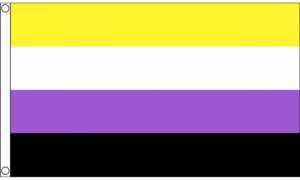
3. Does ‘non-binary’ always mean ‘transgender’?
For me, this is complicated.
I’m non-binary/genderqueer and AFAB (assigned female at birth, in case you’re not familiar with that term) and that does put me under the trans umbrella. The trans community is my community. But even when I identified as a queer woman, I felt that they were my community. LGBTQIA+ is a community of solidarity and anyone who claims otherwise needs a history lesson.
Meet the Trans Women of Color Who Helped Put Stonewall on the Map – Mic.com
But I also do want to acknowledge that I have massive privilege over trans men and women. In general, I can ‘hide in the middle’: I don’t have to come out where it doesn’t feel safe; I can pass as the ‘she’ listed on my ID; I can use the toilets that smell better, unchallenged; I don’t rely on medication. The list goes on.
So I’m wary of fully saying ‘Yes, I’m trans’. But I’m definitely standing there under the trans+ umbrella.
4. Isn’t this a terrible time to stand under the trans umbrella?
Yup. Things are messed up right now. In the US most obviously, but trans hatred is being given media support everywhere. This doesn’t necessarily mean more people are transphobic. But the media manipulates opinions through misinformation, and can give boldness to hatred.
There are people I’m more nervous of. There are situations where I’m at best wary of being open about my gender. There are situations where I choose not to be open, out of fear. For some people reading this, I might already be being put in a certain ‘box’ in your brain.
What does gender identity mean for work, for community, for travel? I already deal with this stuff from being disabled, from being queer, and from being AFAB. Why on earth would I want to make things even worse? Why does it matter?
If you’re genuinely asking this, I think that’s a great question, and one worth remembering for all trans+ people.
For all those negatives, the positives have really got to be worth it! And the point is: yes, they are.
The mental health and quality of life gives me more than the bigotry takes. (This obviously does not make the hatred ok. The trans experience shouldn’t be a trial by ordeal.)
5. How do I know?
The other big question people ask is how I know this about my gender identity. But for me, trying to explain why I am non-binary is like trying to explain love (romantic or otherwise). You can list someone’s attributes, and what you like about them, but you can’t ever fully describe why you look at someone you love and think ‘Yes: you’.
Exploring my identity and its more masculine aspects gives me more and more moments of looking in the mirror and thinking ‘Yes: you’.
Being a woman was just how I was always told I was. Whatever; ok. It didn’t use to give me active dysphoria as such. But stepping outside of that is joyful. It makes me more confident, happier, better at navigating and experiencing life.
Danny Reinan describes this beautifully in a 2021 article in The Echo.
A chair that fits
Having said that, as I come to understand how that ‘correct fit’ of gender works on me, and shed some things I have realised were only masks, I have started to feel dysphoric about some things.
It’s like if you’ve been sitting in the same chair your whole life. It’s the one you’ve always used, and you’ve never really thought about it. It’s fine, right?
Then you try out a super-comfortable ergonomic design genius of a chair, and things feel transformed! The more you use the new chair, the more you feel where the old one was sticking into you and giving you a bad back.
Trans people have always existed
Everyone deserves a chair that fits. Trans people have always been here, and always will be here. From Nazi Germany to the Trump/Musk administration, people can try all they like to scrub records and withdraw rights and supports.
- The Forgotten History of the World’s First Trans Clinic – Scientific American
- Here are all the ways people are disappearing from government websites [US]- NPR
Please fight these changes all you can so the trans community isn’t involved in a constant trial by ordeal.
But however hard we fight these battles, transness people, in all our diversity, have always been here, and always will be.